
Trump operatives seek to seduce both Quebec and Alberta separatists to break-up Canada toward U.S. annexation
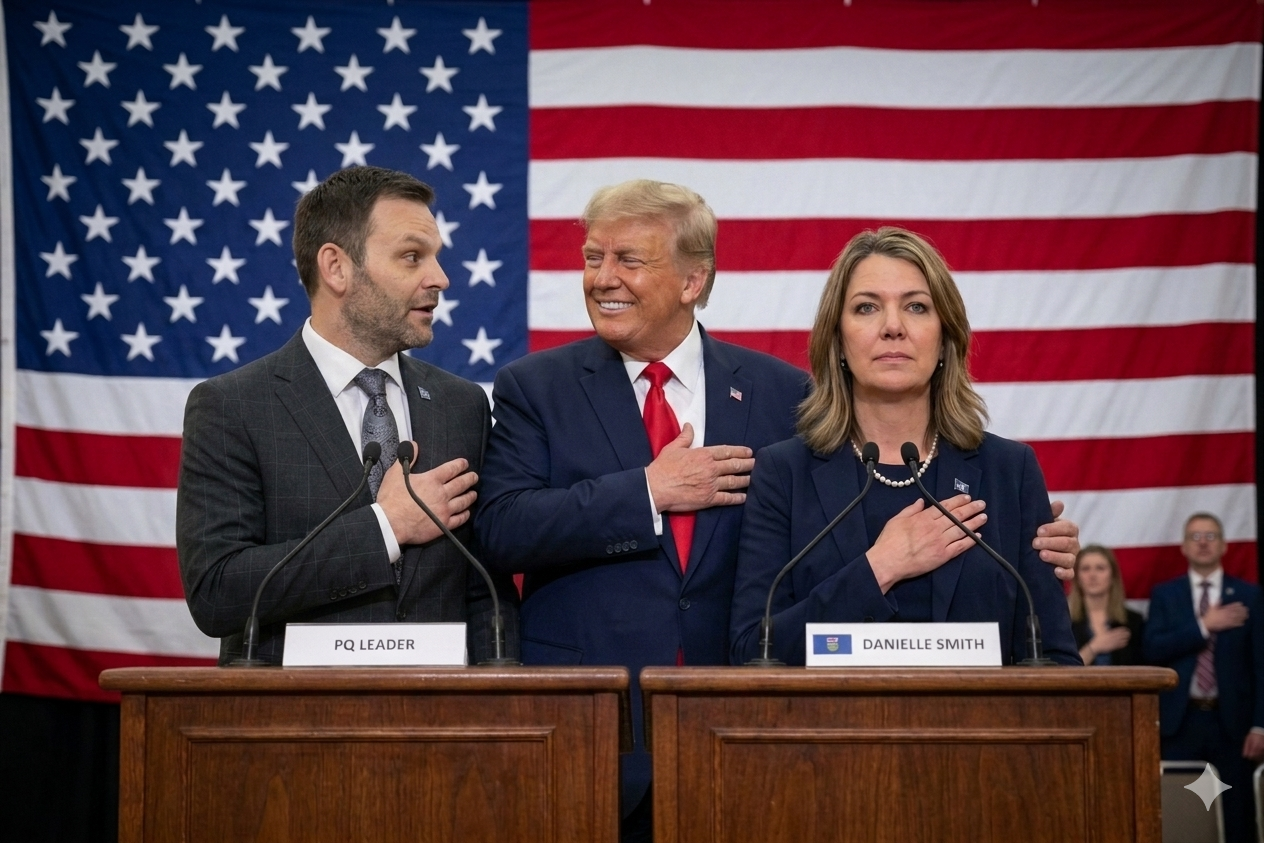


Legal disclaimer: Please note that the accompanying image is only for entertainment purposes and does not reflect an actual event.
The late Prime Minister Wilfrid Laurier famously declared that the twentieth century belonged to Canada. He did not live to see the twenty-first, an era in which the very survival of the Canadian state is no longer a given, but an urgent, live geopolitical question. For generations, Canadians viewed the threat of national dissolution through an internal lens: the historic friction between English and French Canada, or the deep-seated grievances of the West against Central Canadian hegemony. Today, that comfortable domestic paradigm is obsolete. The existential threat to Confederation is no longer merely home-grown. It is being actively, meticulously engineered from the outside, driven by an American administration that views its northern neighbour not as an ally, but as an acquisition.
Recent disclosures have laid bare a coordinated, well-funded effort by operatives aligned with U.S. President Donald Trump to destabilize Canada. This is not a standard diplomatic skirmish over supply management or automotive trade corridors. It is a systematic attempt to seduce, fund, and co-opt separatist movements in both Alberta and Quebec. By leveraging regional grievances, American transactional actors intend to fracture the Canadian federation, smoothing the path for a long-held MAGA fantasy: the economic, infrastructural, and territorial annexation of Canada’s most valuable assets.
To grasp the full gravity of this continental crisis, one must look at the extraordinary investigative reporting from Politico, which details a level of foreign interference that, in any other era, would be treated as an overt act of political warfare. Far-right American network interests—the "Republic" machine—are no longer just watching Canada’s internal fractures with idle curiosity. They are actively bankrolling them, mapping out a future where Ottawa is bypassed entirely, as laid out in Politico's analysis of modern secession architecture.
The Alberta Pipeline of Greenbacks and Grievance
In Western Canada, the pipeline of American influence flows directly into the heart of the Alberta separatist movement. For years, groups like the Alberta Prosperity Project (APP) operated on the fringes of provincial discourse, dismissed by mainstream analysts as eccentric radicals. No longer. We now know that APP officials have held high-level, closed-door meetings with senior Trump administration figures, including prominent Wall Street billionaires and close Trump economic advisers. The substance of these talks, uncovered by Politico, is chilling.
Alberta separatists reportedly approached U.S. Treasury officials requesting a staggering $500-billion line of credit. The explicit purpose of this massive credit facility is to "bankroll the province" in the event of a successful independence vote, insuring the region against the immediate economic shock of separation. It is designed to guarantee liquidity during a transition to independence—or, more accurately, a transition directly into U.S. protectorate status. British Columbia Premier David Eby did not mince words when these secret meetings came to light, rightly branding the collaboration with a foreign government to hasten the destruction of Canada as nothing short of "treason."
This financial courtship has yielded immediate, material consequences on the ground. Obscure separatist entities and third-party advertising groups in Alberta have experienced a mysterious, unprecedented surge of cash. Traced back by financial watchdogs to out-of-province donors and deep-pocketed American political action committees, this capital is being used to build a sophisticated digital infrastructure. Its purpose is to mainstream the idea of Alberta sovereignty, dress up U.S. annexation as an economic promotion, and exploit the deep friction between Prime Minister Mark Carney and Donald Trump, as documented by Politico.
Where is the provincial government in all of this? Premier Danielle Smith has maintained a public posture of plausible deniability, asserting that the United Conservative Party is not an independence party and that Albertans ultimately want to remain within Canada. But her actions tell a far more damaging story. To her critics, and to anyone tracking the systematic erosion of federal norms, Smith is granting these MAGA-aligned operations her quiet blessing.
Her administration has continuously tipped the scales in favour of the separation narrative by introducing legislative mechanics like the Alberta Sovereignty within a United Canada Act and lowering the political threshold required to trigger a separation referendum. By refusing to mount a robust, principled, and uncompromising federalist defence, she has created a dangerous constitutional vacuum. In politics, vacuums are always filled. In this case, it is being filled by American operatives carrying blueprints for secession and advice on how to dismantle a G7 nation from within.
The Quebec Seduction: Resources for the Military-Industrial Complex
If the American strategy in Alberta relies on raw capital and fossil-fuel kinship, the approach in Quebec is altogether different. It is rooted in a cynical game of diplomatic vanity and strategic resource exploitation. The primary target of this continental seduction is Paul St-Pierre Plamondon, the leader of the Parti Québécois (PQ), whose international movements have been closely monitored by Politico.
Plamondon has recently boasted of a "covert diplomatic offensive," acknowledging that his party is engaged in highly confidential conversations with foreign entities to prepare for Quebec’s independence. He frames this secrecy as necessary statecraft, telling reporters, "I cannot reveal each of the confidential conversations we are having." Federalists and clear-eyed observers rightly see it as something far more sinister: the systematic erosion of Quebec’s long-term security in exchange for early recognition by an expansionist neighbour.
Federal Industry Minister Mélanie Joly cut through the diplomatic pleasantries on Parliament Hill, explicitly accusing the PQ leader of wanting to "hand Quebec over to Donald Trump" and "throw it into the arms" of the American president. Her assessment, while politically charged, is structurally and geopolitically accurate. The PQ’s newly unveiled Livre bleu outlines a vision for closer economic and diplomatic alignment with Washington, arguing that Canada no longer acts as an effective shield against global instability.
But this is an extraordinary inversion of reality. An independent Quebec would find itself utterly isolated, stripped of the massive economic shield, transfer systems, and regulatory protections provided by the Canadian federation. It would enter the global stage not as an equal partner, but as an incredibly vulnerable state forced to accept whatever terms Washington dictates.
Why does the Trump administration care about Quebec sovereignty? The answer does not lie in an affection for French-Canadian culture; it lies beneath the rock of the Canadian Shield. Trump’s political-military-industrial complex has a voracious, unappeasable appetite for critical minerals—lithium, graphite, cobalt, copper, and rare earth elements. These minerals are the indispensable building blocks of the next century’s technological, industrial, and military hegemony. Quebec possesses them in abundance.
Under current Canadian federal law, foreign takeovers of these strategic resource sectors are heavily restricted under national security provisions to prevent authoritarian or predatory foreign states from buying up domestic supply chains. But an independent Quebec, starved for capital, locked out of Canadian markets, and desperate for international recognition, would be completely defenseless against American corporate dominance. Trump’s operatives are playing a textbook long game: flatter Plamondon’s sovereignist ambitions, help him break away from Ottawa, and then dictate the predatory terms of Quebec’s economic surrender. The province would not become a proud, independent francophone republic; it would be functionally reduced to a resource colony for Washington's industrial machine. Plamondon’s defence—that an independent Quebec would be better positioned to negotiate directly with Washington—is a delusion of historic proportions. To believe that a nascent nation of nine million could sit across a table from a Trump-led superpower of 340 million and protect its sovereignty is not statecraft; it is geopolitical suicide.
The Federal Counter-Offensive: Carney's Line in the Sand
For too long, Ottawa treated provincial separatism as a localized, domestic political irritant to be managed with electoral calculations or quiet diplomacy. That era of passive management has ended. Prime Minister Mark Carney has recognized this pincer movement for what it truly is: a coordinated foreign interference campaign targeting the territorial integrity and national sovereignty of Canada.
Carney’s domestic response is anchored in a hardline economic federalism. The federal government is deploying regulatory instruments to systematically choke off the flow of illicit foreign capital into provincial political entities. By treating cross-border PAC funding directed at separatist organizations as an explicit national security threat, Ottawa is using the full weight of the Financial Transactions and Reports Analysis Centre of Canada (FINTRAC) and the Investment Canada Act to freeze accounts and block unauthorized credit lines before they can disrupt the national economy. Furthermore, Carney has drawn an uncompromising line regarding critical infrastructure, signalling that federal control over national ports, international trade corridors, and inter-provincial pipelines will be maintained by any means necessary, neutralizing the financial "viability arguments" pushed by secessionists and detailed by Politico.
Yet, defensive measures alone will not suffice to survive a continental siege. To truly counter Trump's predatory strategy, the Canadian federal government must launch an asymmetric counter-offensive that mirrors the very tactics being used against us. If Washington intends to subvert our federation by courting disgruntled provinces, Ottawa must bypass Washington to build direct alliances with like-minded American states and small business owners who rely heavily on a stable, unified Canadian market.
Seducing the Border States: The New Asymmetric Front
Canada must actively woo progressive and economically dependent border states—extending from California and Washington in the west to New York, Vermont, and Maine in the east—alongside American small business coalitions. For states like Vermont and Maine, the economic and social realities are deeply intertwined with Canadian stability. Vermont relies heavily on Hydro-Québec for its clean energy grid, a relationship that underpins the state’s aggressive climate goals. Maine’s forest products, tourism, and maritime trade are fundamentally integrated with Atlantic Canada and Quebec.
By positioning a strong, unified Canada as the ultimate institutional check on Trump's unpredictable executive overreach, Ottawa can build a powerful economic lobby within the United States itself. When Canadian diplomats engage directly with governors and chambers of commerce in Montpelier and Augusta, the message must be bold: a fractured Canada means fractured supply chains, volatile energy prices, and immediate economic disruption for American small businesses. We should openly invite these states and business entities to deepen their structural integration with Canada, offering them a sanctuary of regulatory stability, secure supply chains, and green energy corridors.
Crucially, this campaign should be leveraged as geopolitical currency. Ottawa must make it clear that Canada will stop building this sub-national American alliance only when the Trump administration explicitly stops seeking to undermine and dismantle the Canadian state. It is a strategy of mutual deterrence. If Washington uses the threat of disintegration against us, we will use the threat of economic realignment and open invitations of integration with northern-aligned states against them.
The Shield of History: Lessons in Resistance
This is not the first time Canada has had to deploy creative, aggressive statecraft to survive American expansionist or economic pressure. History provides the exact playbook Carney is now modernizing. The very founding of Canada in 1867 was a direct counter-offensive against American territorial ambitions. In the wake of the American Civil War, faced with the doctrine of Manifest Destiny and the sudden cancellation of the Reciprocity Treaty in 1866, Britain’s North American colonies recognized that their independent survival was impossible. They chose federal unification specifically to build a transcontinental economic shield capable of resisting American annexation.
A century later, Canada faced another existential threat during the 1971 "Nixon Shock," when U.S. President Richard Nixon abruptly imposed a 10 per cent import surcharge that threatened to devastate the Canadian economy. Rather than surrendering to Washington’s terms, Prime Minister Pierre Trudeau launched the "Third Option" policy. Canada systematically worked to diversify its trade away from the United States while aggressively lobbying sub-national American actors, congressmen, and border-state business interests to demonstrate how harming Canada would directly damage the American heartland. Nixon ultimately exempted Canada from key aspects of his economic pressure campaign because Ottawa successfully mobilized America's own domestic economic engines against the White House.
The True Nature of the Conflict
The forces currently pulling most violently at the seams of Confederation are being directed, funded, and advised by an aggressive foreign power operating inside our borders, a reality laid bare by the investigative work at Politico. A Canada without Alberta is an economically crippled state; a Canada without Quebec is a geographically severed one.
The federal government in Ottawa can no longer afford to treat provincial separatism as a localized political irritant. It must be recognized for what it truly is: a coordinated foreign interference campaign targeting the territorial integrity and national sovereignty of the country. If the federal government, and indeed ordinary citizens across every province, do not wake up to the harsh reality of this continental siege, we may soon find that the twenty-first century did not belong to Canada at all. It belonged to the empire next door, which simply waited for us to let them tear us apart.

Comments
There are 0 comments on this post